
If you have spent any time researching hardwood floors, you have run into the phrase “Janka hardness,” usually attached to a number you are expected to already understand.
Here is what that number actually measures, what it does and does not tell you about how a floor will hold up in your home, and how the species we carry stack up against one another.
What is Janka hardness?
The Janka hardness rating measures a wood species’ resistance to denting and wear.
The test itself is refreshingly simple. A .444-inch steel ball is pressed into a plank until half the ball is embedded, and the force required to get it there is recorded in pounds-force (lbf) in the United States. That number is the species’ Janka rating. The higher the number, the harder the wood.
Because it is a single, repeatable test, Janka gives you an apples-to-apples way to compare species that otherwise have very little in common. Keep in mind that published numbers vary slightly between testing sources, and that wood is a natural material — two boards of the same species are never identical.
How to read the numbers
The ratings only mean something in relation to each other. As a rough guide for flooring:
- Under 1,000 lbf. Softer species that dent more easily. Beautiful, but they will collect character — and if you love a lived-in floor, that is a feature rather than a flaw.
- 1,000 to 1,300 lbf. The middle of the road, and where most traditional flooring species land. Durable enough for family life without giving up warmth or grain character.
- 1,300 lbf and above. The hard end of the spectrum. A sensible choice for entryways, kitchens, big dogs, and houses where the floor takes a beating.
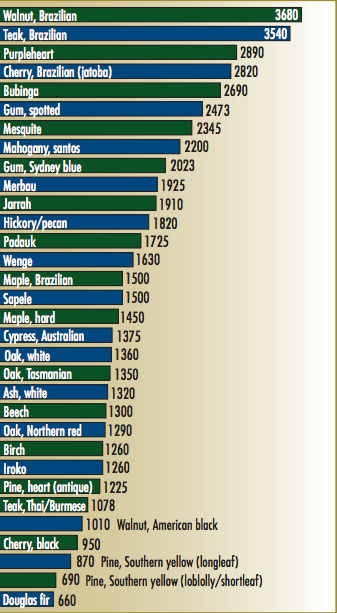
Credit: NWFA
Janka ratings by species
Here is where the species we stock fall on the scale, hardest to softest:
| Species | Janka rating (lbf) | Best suited to |
|---|---|---|
| Hickory | 1,820 | High-traffic rooms, active households with kids and pets |
| Hard maple | 1,450 | Kitchens, playrooms, anywhere that takes daily abuse |
| White oak (including reclaimed) | 1,360 | Whole-home installations, kitchens and baths |
| Ash | 1,320 | Halls, entryways, open-plan living space |
| Red oak (including reclaimed) | 1,290 | Whole-home installations, traditional interiors |
| Yellow birch and red birch | 1,260 | High-traffic rooms and humid climates |
| Reclaimed heart pine | 1,225 | Rustic interiors that still see heavy use |
| American walnut | 1,010 | Bedrooms, dining rooms, formal living space |
| American cherry | 950 | Studies, family rooms, low-traffic areas |
| Longleaf heart pine | 870 | Farmhouse and period homes where patina is the point |
The hardest: hickory and hard maple
Hickory is the toughest domestic species we carry at 1,820 lbf, which is roughly 41 percent harder than red oak — and it happens to be one of the most dramatic-looking, with wide swings in color from plank to plank and plenty of natural character marks. If you have a busy entry hall, a large dog, or children who treat the living room as a hockey rink, it is hard to beat.
Hard maple at 1,450 lbf is the wood used for basketball courts and bowling lanes, which tells you most of what you need to know. Its look is the opposite of hickory: pale, tight-grained and quiet, which makes it a natural fit for bright, contemporary rooms.
The dependable middle: oak, ash, birch and reclaimed heart pine
White oak (1,360) and red oak (1,290) are the American flooring standards for good reason. Both are plenty hard for a whole house. The practical difference is not durability but behavior: white oak is more dimensionally stable, takes stain more evenly, and is naturally more water-resistant, which is why we usually steer homeowners toward it for kitchens and bathrooms. Red oak has warmer, pinker undertones and a more pronounced grain.
Ash (1,320) is creamy in color with bold, open grain and stands up to high traffic beautifully. Yellow birch (1,260) is the most variable of the group, with striking contrast between boards, and it handles humidity swings well; red birch is the heartwood of the same tree, so it tests in the same range while reading warmer and more uniform.
Reclaimed heart pine deserves a special note. Standing at 1,225 lbf, it is far denser than the pine most people picture, because it comes from old-growth timber that grew slowly and tightly. You get knotty, historic character with something close to hardwood durability.
Softer and character-driven: walnut, cherry and longleaf heart pine
American walnut (1,010), American cherry (950) and longleaf heart pine (870) sit at the soft end — and they are among the most beautiful floors you can put in a house. Walnut brings deep chocolate tones, burls and figure that nothing else matches. Cherry starts reddish and deepens gorgeously with age. Longleaf heart pine has that orange-red glow and prominent knots you see in centuries-old homes.
These will dent. A dropped cast-iron pan will leave a mark. Put them in bedrooms, studies, dining rooms and formal living spaces rather than the mudroom, and choose them knowing that the marks they collect are part of the appeal.
For a fuller picture of how each of these species looks and behaves, see our species descriptions guide.
What Janka does not tell you
Hardness is one input, not the whole answer. Several other factors matter just as much for how a floor wears:
- The finish. A quality finish system is the layer your shoes and furniture actually touch. A well-finished cherry floor can outperform a poorly finished hickory one.
- The cut. Quarter sawn and rift sawn boards are more dimensionally stable than plain sawn, meaning less movement with seasonal humidity changes.
- Color and texture. Lighter floors, heavy graining, wire brushing and distressing all hide dings far better than a smooth, dark, glossy surface. Texture is often a better dent strategy than hardness.
- Your habits. Felt pads on furniture legs, doormats at every entry, trimmed pet nails and a no-heels-indoors rule will do more for your floor than 300 points of Janka.
Matching hardness to your household
A useful way to decide: think about the room, not the house. Entryways, kitchens, hallways and family rooms are where a higher Janka number earns its keep. Bedrooms, studies and formal spaces give you room to choose with your eye instead.
Then be honest about the household. Two adults in a quiet home can put walnut almost anywhere. Three kids, two dogs and a side door that opens onto a gravel driveway argue for hickory, maple or white oak in the main paths, with the softer species saved for rooms that see less traffic.
The bottom line
Janka hardness is an objective way to compare species, and it is genuinely useful for narrowing the field. But it is a starting point, not a verdict. The best floor is the one that suits both how your home looks and how your family lives in it — and with the right finish and a little care, most of these species will be underfoot long after the decision stops feeling difficult.
Have questions about a specific species? Browse our species guide or get in touch. We are happy to talk through your project.